Tools+Resources
Tools+Resources
The Playbook
The Playbook
The Practitioner's Guide
The Practitioner's Guide
by
Sukari Keetin
The framework explained the reasoning. The guide puts that reasoning into action.
In Designed to Be Read, I describe four layers where AI shapes how content connects with its audience. The Conversational Layer is where systems ask questions. The Semantic Layer is where systems make inferences. The Agentic Layer is where systems take action. The Infrastructure Layer is where the underlying systems decide what is visible to everyone else.
Each layer presents its own design challenge and needs its own standards. Most content systems today do not address these challenges well, if at all.
Identifying the problem is important, but it is only the first step.
Now that the problem is clear, the next step is The Practitioner's Guide.
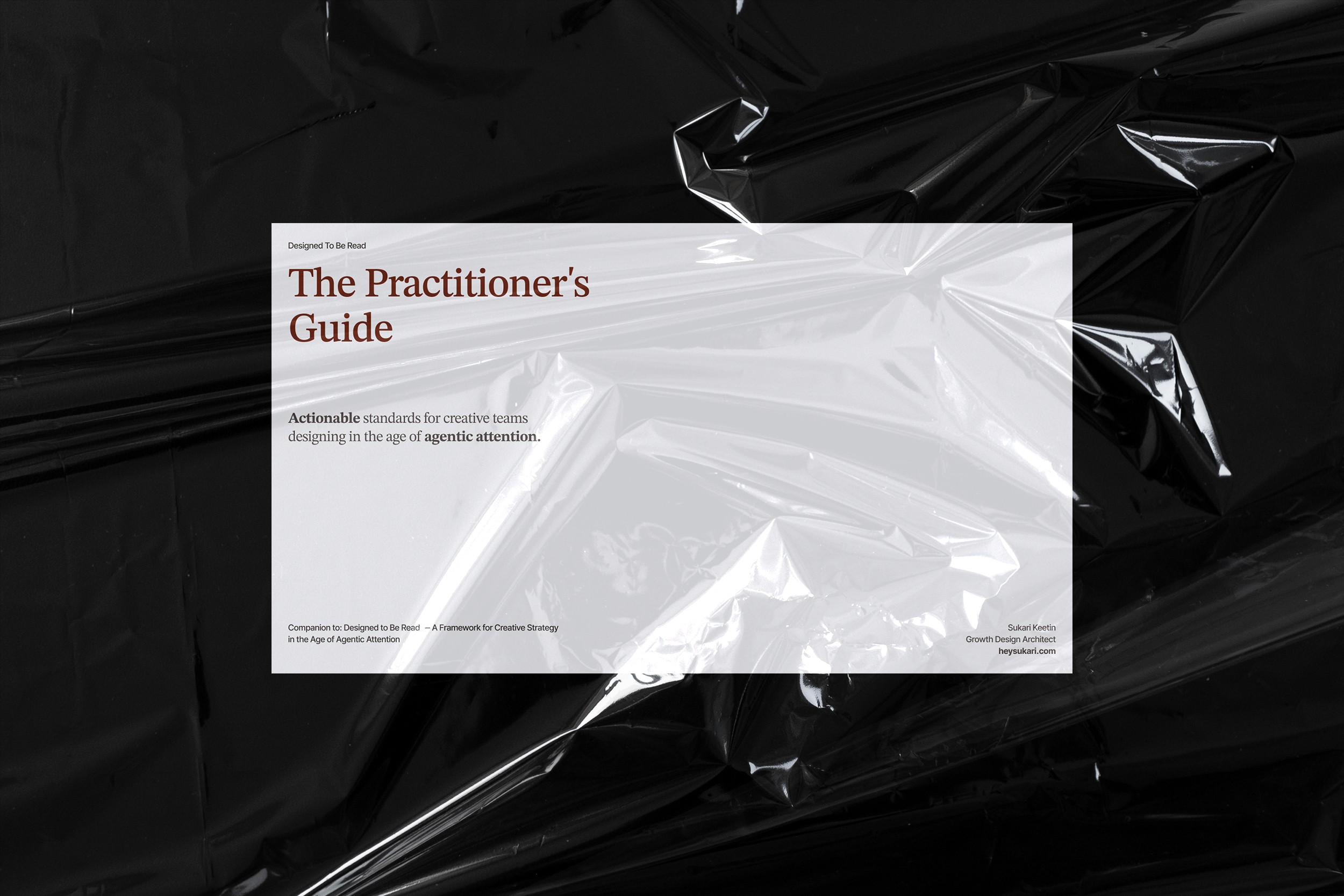
The Practitioner's Guide is my working document and method. It includes the standards I use to review design processes and systems, audit checklists I rely on before suggesting changes, my updated brief template for the agentic attention era, and guidelines for turning the framework into practical team decisions.
It is not a course or a strategy document. It is a tool designed for immediate, real-world use. It turns principles into a practical resource that helps teams put the framework into action quickly.
The guide is set up so a creative director can give it to their team on Monday and have a working framework for reviewing their email design system, content structure, and brief process by Friday. It is for people who already know the problem and the framework, and who need a clear way to take action.
This guide is not for designers seeking tactical tips. It is for those who need to convince their leadership to change how their team works in the agentic attention environment.
Thank you for reading through to the end.
— Sukari
The framework is now available. Get The Playbook.
If something sparks a thought — or a disagreement — I'd love to hear it.
Share your thoughts or insights at newsletter@heysukari.com.
The framework explained the reasoning. The guide puts that reasoning into action.
In Designed to Be Read, I describe four layers where AI shapes how content connects with its audience. The Conversational Layer is where systems ask questions. The Semantic Layer is where systems make inferences. The Agentic Layer is where systems take action. The Infrastructure Layer is where the underlying systems decide what is visible to everyone else.
Each layer presents its own design challenge and needs its own standards. Most content systems today do not address these challenges well, if at all.
Identifying the problem is important, but it is only the first step.
Now that the problem is clear, the next step is The Practitioner's Guide.
The Practitioner's Guide is my working document and method. It includes the standards I use to review design processes and systems, audit checklists I rely on before suggesting changes, my updated brief template for the agentic attention era, and guidelines for turning the framework into practical team decisions.
It is not a course or a strategy document. It is a tool designed for immediate, real-world use. It turns principles into a practical resource that helps teams put the framework into action quickly.
The guide is set up so a creative director can give it to their team on Monday and have a working framework for reviewing their email design system, content structure, and brief process by Friday. It is for people who already know the problem and the framework, and who need a clear way to take action.
This guide is not for designers seeking tactical tips. It is for those who need to convince their leadership to change how their team works in the agentic attention environment.
Thank you for reading through to the end.
— Sukari
The framework is now available. Get The Playbook.
If something sparks a thought — or a disagreement — I'd love to hear it.
Share your thoughts or insights at newsletter@heysukari.com.